FAQs
FAQs
What size ball does my trailer require?
Up to 7500lb GVWR with brakes – 2” Ball Hitch/ Anything greater than 7500lbs GVWR with brakes – 2 5/16” Ball Hitch
Up to 7000lb GVWR without brakes – 2” Ball Hitch/Anything great than 7000lb GVWR without brakes – 2 5/16” Ball Hitch
What type of grease should I use for my bearings?
Dexter Ultra Lube is recommended. It is a Lithium complex base (not calcium, not bentonite), NLGI #2, high-temp rating suitable for wheel bearings, water-resistant especially for boat trailers, and compatible with disc brakes.
However, if you are looking to substitute for a different brand, make sure to use a Lithium complex, NLGI #2, high-temp, water-resistant grease. It is NOT recommended to use Marine grease that is calcium sulfonate only unless confirmed compatible, a low-temp chassis grease or mixing grease types.
What is the difference between posi lube & buddy bearings?
Posi-Lube
This is a popular trailer axle lubrication system that lets you repack wheel bearings without disassembling the hub, making maintenance quick and easy by injecting grease through a fitting at the spindle end, which flows to both inner and outer bearings, purging old grease out the grease cap. It’s designed for towable axles, including marine use (submersible), uses lithium complex #2 grease, and requires you to pump grease while rotating the wheel until clean grease appears, but it doesn’t replace periodic full bearing inspections.
https://youtu.be/XT0RKDGgDm8?si=ROFlyi3n3KyTaYPb
Bearing Buddy
The axle hub is filled with grease until the grease forces the Bearing Buddy® piston outward about 1/8 inch. Because the piston is spring loaded, the piston exerts a slight (3 PSI) pressure against the grease, which maintains a slight pressure between the inside of the hub and the outside environment. When the hub is submerged, water cannot enter the hub because of this pressure. An automatic pressure relief feature prevents over-filling and over pressurization. See Bearing Buddy diagram: Without this feature, the inner seal will be damaged.
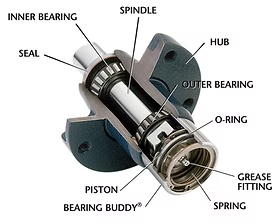
Grease can be added to the hub through an easily accessible grease fitting located in the center of the piston. Lubricant level (and pressure) can be checked quickly by pressing on the edge of the movable piston. If you can rock or move the piston, the hub is properly filled. In addition to packing the bearings in the traditional manner, it’s best to get as much grease as possible inside the hub cavity between the bearings and then, while the Bearing Buddy® is off, fill it with grease as well from the backside. The air pockets inside the hub cavity and Bearing Buddy® will work their way out past the piston (or blue ring) on the Bearing Buddy®.
You should see the piston extend out or the blue ring past the front of the Bearing Buddy® when it’s properly filled. However, as air escapes the piston (or blue ring) is going to collapse inward. This is normal. After driving several miles, check the piston (or blue ring) to see if it has moved inward. If it has, add a little more grease to get the piston to move outward or the blue ring to move about 1/8″ past the front of the Bearing Buddy®. You may have to do this a couple of times before all the air pockets are gone and the entire hub cavity is filled with grease.
Bearing Buddy® will last the life of your trailer. The outer barrel is made of steel and is triple chrome plated. Internal Bearing Buddy® parts are made of stainless steel. Bearing Buddy® is also available with a stainless steel barrel for maximum corrosion protection.
What is the difference between spring axles & torsion axles?
The difference between spring axles and torsion axles are as follows:
Spring Axles
How it works
- Axle sits on or under leaf springs
- Springs flex to absorb bumps
- Everything is bolted together in a very mechanical, very visible way
Torsion Axles
How it works
- Each wheel is independently suspended
- Rubber torsion cords absorb road impact
- Axle is sealed and compact
What PSI should be tires be inflated to?
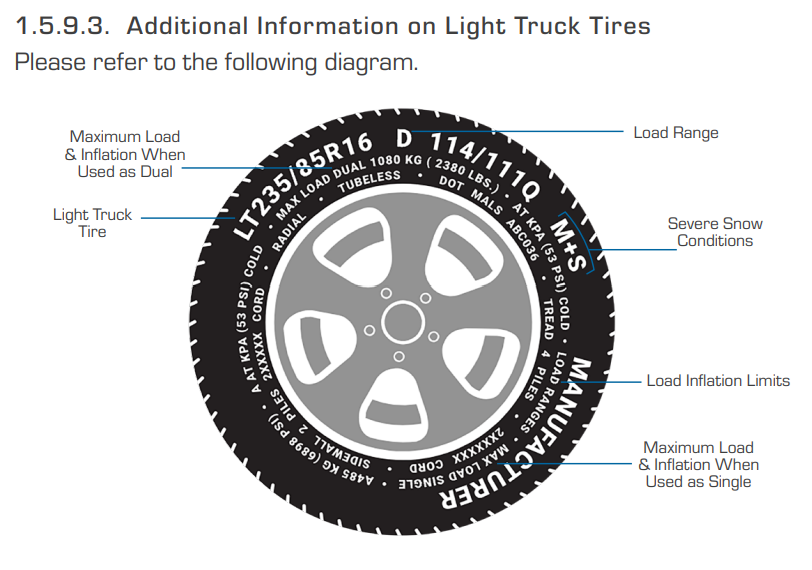
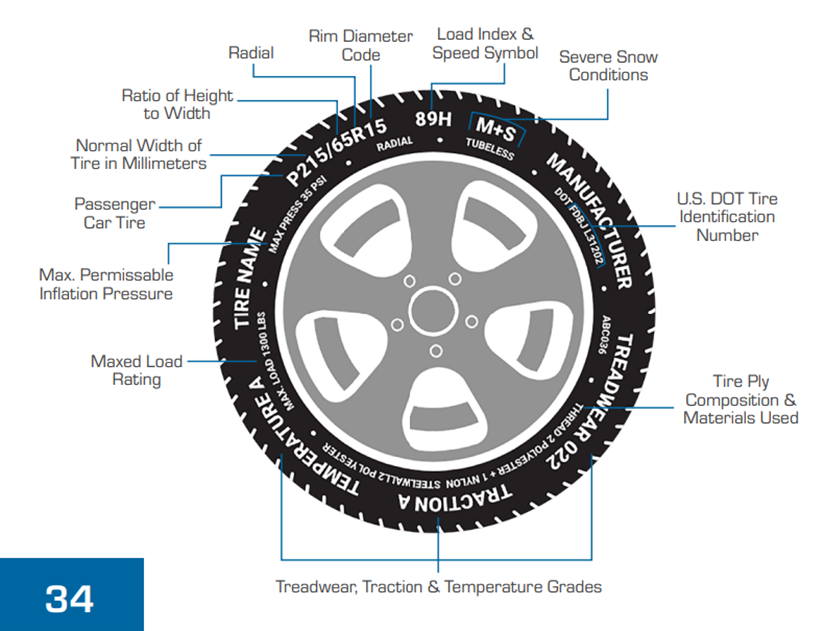
The tire inflation pressure is a number that indicates the amount of air pressure– measured in pounds per square inch (psi)–a tire requires to be properly inflated. (You will also find this number on the vehicle information placard expressed in kilopascals (kpa), which is the metric measure used internationally.)
The proper tire pressure for your vehicle is referred to as the “recommended cold inflation pressure.” (As you will read below, it is difficult to obtain the recommended tire pressure if your tires are not cold.) Because tires are designed to be used on more than one type of vehicle, tire manufacturers list the “maximum permissible inflation pressure” on the tire sidewall. This number is the greatest amount of air pressure that should ever be put in the tire under normal driving conditions.
You can get additional information on tire maintenance in our Owner’s Safety Manual pages 23-36.
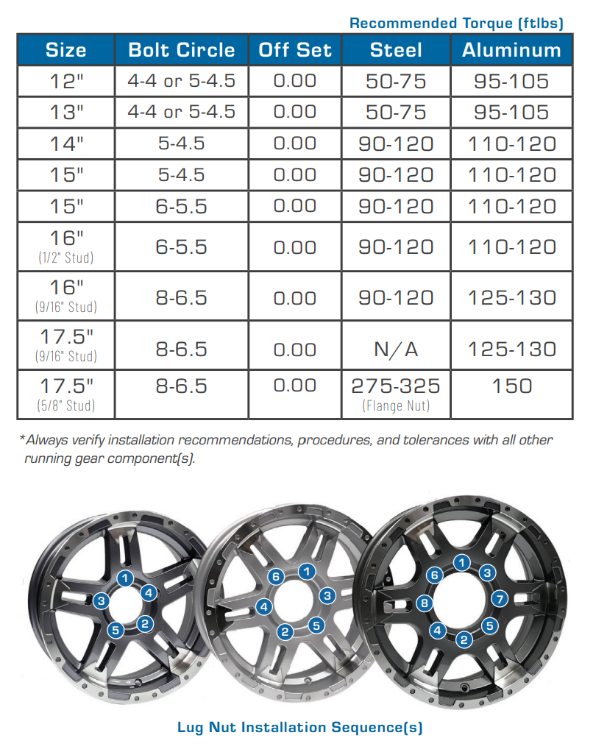
What is the torque specs for my lug nuts?
Loose lug nuts can lead to the loss of a wheel! Before each trip, check for loose or missing lug nuts. When tightening lug nuts, use a wrench of the right size, and torque the nut to the manufacturer’s specifications. Be certain a replacement nut is an exact match for the original. While the threads of the lug nut may match, the nut may be a size that does not hold the wheel securely against the hub, even when fully tightened. Also, ensure that the wheel bolts and nuts are clean and grease-free. More information can be found in the Owner’s Safety Manual on page 38.
Where do I find the VIN number for my trailer?
The VIN (Vehicle Identification Number) is attached to the left forward side of your trailer (inside the frame). It shows the maximum load-carrying capacity of the trailer. This label is required to show the Gross Vehicle Weight Rating (GVWR), which is the load-carrying capacity PLUS the weight of the trailer itself.
How do I obtain a replacement VIN label or Certificate of Origin for my trailer?
To research your MSO (certificate of origin) or VIN label request, we will need proof of ownership. Please send one of the following:
- Bill of Sale with 17-digit VIN number (Notarized if private sale)
- Registration
- Title
Feel free to include any other supporting documentation. Make sure you include Name, Address and Contact Information.
Once we receive your information, we will research and process your request. Please see the fee schedule below. Fees are payable by Visa or Mastercard. Once we have the document ready, we will call you to obtain payment. Please do not send credit card info.
We have very limited information available for trailers manufactured before 2006. We will do our best to help you with the information available.
There is currently a 2-4 week turnaround on MSO & VIN label requests.
Fee Schedule:
$50 MSO (Certificate of Origin)
$50 Label
$75 MSO and Label (requested at same time)
There is a 3% processing fee on all credit card payments.
Should I purchase an Aluminum or Galvanized trailer?
Determining which type of trailer to purchase requires identifying what it will be used for.
Aluminum – Good For
- Saltwater use
- Frequent launching
- Keeping the trailer as long as the boat
- Rust Resistance
Why people love it
- Won’t rust. Ever. Saltwater will not affect the material.
- Lighter weight means easier towing, less strain on your truck, slightly better fuel economy.
- Looks clean longer. No flaking, no orange stains.
Galvanized – Good For
- Freshwater lakes
- Occasional saltwater use with religious rinsing
- Shorter ownership cycles
- Buyers prioritizing upfront cost over long-term peace
Why people buy it
- Lower initial cost. Less expensive.
- Zinc coating protects steel from rust.
How do I get pricing for a trailer from Magic Tilt?
Magic Tilt Trailers is a wholesale manufacturer. You can contact an authorized dealer in your area to get pricing. If you are purchasing a boat/trailer package, you can ask your dealer to price a Magic Tilt Trailer.
You can also configure your trailer on our website under the Trailers tab and then send the configuration directly to a dealer near you.
Our dealer search can be located here: Dealer Search
Does Magic Tilt offer service for my trailer?
Magic Tilt does offer service for your trailer. You can request service by completing the form using the following link: Service Request
Does Magic Tilt have a setup for my boat?
Magic Tilt has setups for over 10,000 boat models. If you ask your dealer for a Magic Tilt Trailer and we do not have a setup for it, we have the capabilities to scan your hull and create a trailer to custom fit your boat.
What kind of add on options does Magic Tilt offer for my trailer?
Options vary by trailer however, some of the most common options or upgrades to a trailer are:
- Aluminum wheels (black or silver)
- Axles
- Spare tire/spare tire mount
- Custom step-pads
- Ladders
What is the warranty policy for my trailer?
Magic Tilt Trailers, Inc. (Magic Tilt) warrants each new Magic Tilt aluminum trailer to be free from defects in materials and workmanship for a period of two (2) years from date of purchase or three (3) years from the date of manufacturer, whichever comes first. Your trailer must be registered in order for your product to be covered under our Warranty Policy (the trailer registration)
To see the full Warranty Policy, please click on this link: Warranty Policy
4760 EAST BAY DR. STE. B
CLEARWATER, FL 33764

MADE IN THE USA